Copyright 2010 Sara Harding
Showing posts with label France. Show all posts
Monday, August 30, 2010
Sunday, August 29, 2010
A Final Stop: Montmartre
![]() | ||
| The Abbesses stop, designed by Hector Guimard |
I got to Montmartre from Montparnasse by taking Metro line 13 to Montparnasse-Bienvenue and then switching to the 12 and taking it all the way to the famous Abbesses stop with its original art nouveau sign (only three of these are left in Paris). I climbed the long spiral staircase - the stop is 36 meters underground - and stepped out into the beautiful arrondissement of Montmartre.
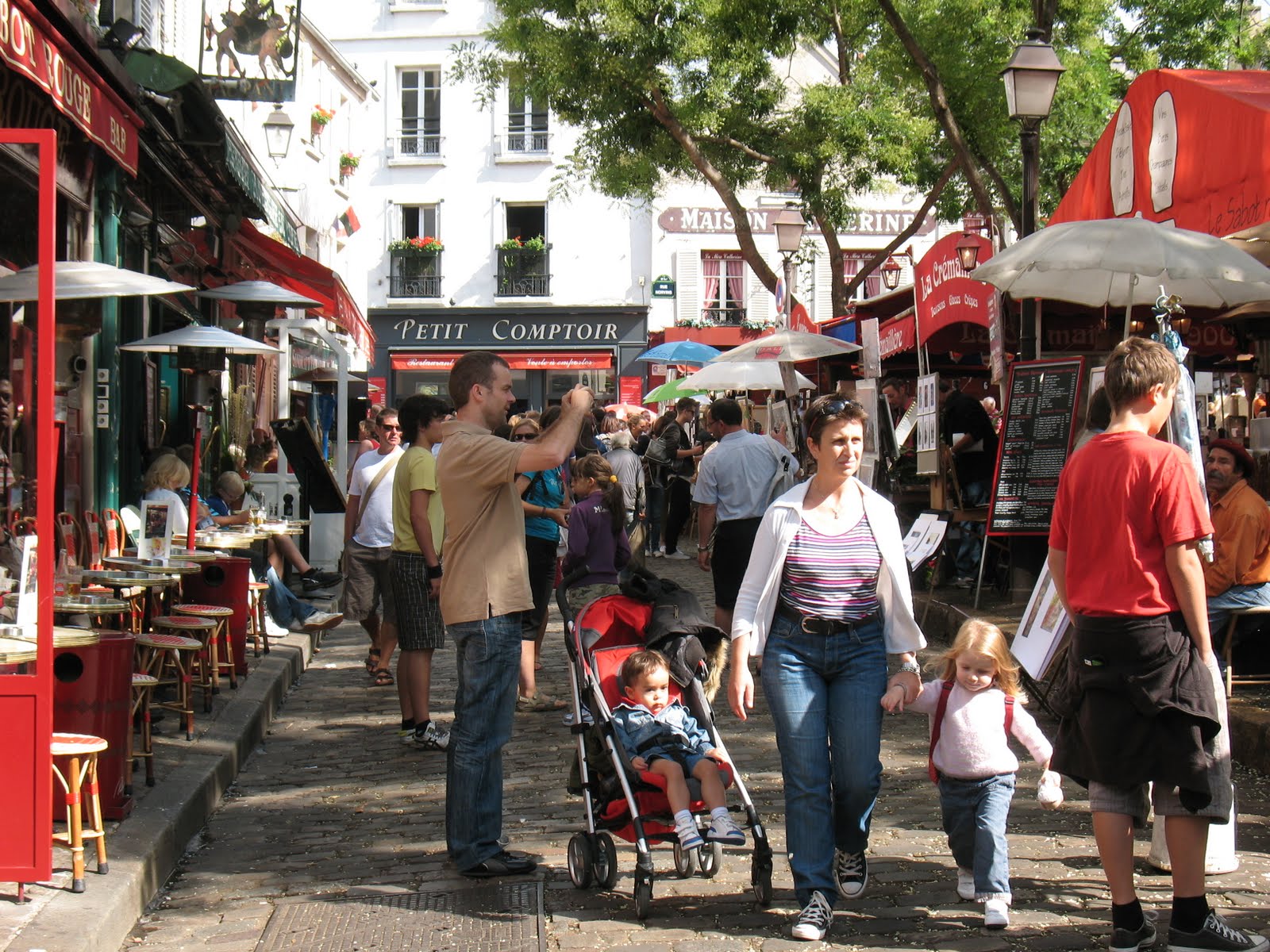
| Artists' kiosks outside a cafe in Montmartre |
![]() |
| Rue Chappe |
My last stop was Cafe Chappe at the bottom of the stairs. After walking up and down a hill for several hours, I was in need of some refreshment, so I ordered a glass of wine and indulged in that most Parisian pastime - watching the world go by through the window of a cafe.
Copyright 2010 Sara Harding
Saturday, August 28, 2010
Saying Goodbye to Paris
![]() |
| The Eiffel Tower at night, taken from a Seine riverboat |
Leaving Paris also marks the end of my stay in Europe. I fly to Rome for a single night, then back to the good old US of A. And do I ever miss it! Whenever I leave America for a long stay overseas, I "say goodbye" to America by enjoying all the things I know I won't have for months to come. Now, I'm practically ecstatic about getting back to them.
Today I'll spend my time walking around Montemartre, a historic neighborhood in Paris that I haven't seen yet (it's where the Moulin Rouge is). Then I'll come home and pack, and tomorrow morning I'll be on my way. It saddens me to say "au revoir" to this beautiful place, but I try to remember that "au revoir" literally means "til I see you again."
Copyright 2010 Sara Harding
Thursday, August 26, 2010
Such a Romantic City...
![]() |
| A detail of Antonio Canova's "Psyche Revived by Cupid's Kiss" (commissioned 1787), in the Louvre. |
Copyright 2010 Sara Harding
Through the Looking Glass
One of the questions that obsesses me is "what is American?" I especially want to know what is American from the outside looking in - what do people from around the world consider American. I also want to know if it's a good thing, a bad thing, a selling point, a deterrent, an approbation, a moral indictment...
What is American?
So I'm always on the lookout for anything labeled "American" when I travel. I studied abroad in Ireland when I was in college and one of my favorite candies - purely for the name, I think - was a product called "American Hard Gums." They were like nothing I'd ever eaten in America. I suppose they most closely resembled gumdrops if you scraped the sugar off the sides, squashed them a bit, and made them slightly harder than stale jujubees. What made them American? I have no idea.
Here's something "American" I stumbled across while wandering around Paris. It hardly seems fair that the French get to the claim French tips and we get stuck with the airbrushed acrylic monstrosities. Which raises the question: are French tips really French?
Though I don't see a way of getting out of claiming acrylic nails as American. And I'm going to have to assume that in a stylish place like Paris, that is not a good thing...
Copyright 2010 Sara Harding
A Taste of What's Out There: Chateauneuf du Pape
I never get French wine in America. First of all, it's expensive. Secondly, I would have no idea what to pick. My experience of European wines is pretty much limited to Italy, so if I have $15 to spend on a bottle of wine, I buy Italian - at least I know what I'm getting. In reality, three-buck-Chuck is more my speed, and though I genuinely enjoy a glass of nice wine, it just isn't in my budget.
So I really wanted to try a good French wine while I was in Paris and could avoid the import taxes. A European friend suggested I get a bottle of Chateauneuf du Pape. The village of Chateauneuf has been producing wine since the 13th century and has a long history of supplying wine to famous clients, including a number of Popes (hence the appellation) and great French writers like Alexandre Dumas.
I walked into a wine shop on Rue Daguerre and in my horrendous French explained that "I search a particular bottle of wine - Chateauneuf du Pape." The kind shop owner suffered through my pronunciation and found me a bottle of the 2007 vintage for 19 euros. Then - because apparently I looked a little too scruffy to be buying a nice wine - asked if he should wrap it as a gift.
"No, I drink it," I declared. And drink it I did.
The wine was a serious departure from my usual range of Californian wines, but in a very good way. It had a mineral nose with hints of earth, medium body, and a well-balanced palate. The fruit flavors were subtler and not as juicy as is typical for American wines, so I can finally understand why my European friends often describe Californian wines as "like drinking jam."
Overall, Chateauneuf du Pape was an excellent introduction to French wines, one I wish I had more time to follow up on! I would strongly recommend it if you, like me, are curious about the famous wines of France but aren't sure where to begin.
Copyright 2010 Sara Harding
Wednesday, August 25, 2010
Visiting the Musee d'Orsay
For most of western history, painting just isn't my thing. I mean, I love what they did at Lascaux, but after that I lose interest for about the next 16, 800 years.
Which makes the Musee d'Orsay the perfect museum of painting, at least for me. The Musee d'Orsay is devoted to impressionism, which is right about where I start to be interested again. With important works by Monet, Renoir, Pissaro, and Degas, exploring the museum is a chance to experience all the highlights of the movement that thumbed its nose at realism and academic painting and took its canvases into the great outdoors.
The Musee d'Orsay also displays works from the origins and aftermath of impressionism, including a small but wonderful collection of Van Goghs. A post-impressionist painter, Van Gogh shared and developed many of the Impressionists' interests, like light, experience, mood, perception, and outdoor painting. The Church at Auvers, one of my all-time favorites and one of the last paintings the artist ever did, is one of the must-sees among the collection. Works by Gauguin are also among the museum's post-impressionist masterpieces.
The Musee d'Orsay is located on Quai Anatole France (oddly enough, not on the nearby Quai d'Orsay) on the bank of the Seine near the Pont Royal. Tickets are 8 euros (not including special exhibits) or free with the Paris Museum Pass.
Copyright 2010 Sara Harding
Tuesday, August 24, 2010
The Writing on the Wall
I love graffiti. Great graffiti is beautiful and thought-provoking: it's art, it's comedy, it's social commentary, it's political protest, it's philosophy. Sure, some graffiti is inane, but some graffiti stays with you and makes you think. And of course, I'm hardly the first person to notice - by this point, artists like Banksy have raised graffiti to an accepted form of artistic expression, with glossy books in the MoMA gift shop and everything.
But just because I'm not setting the trend doesn't mean I can't enjoy it. I'm always on the lookout for interesting graffiti when I'm in a new city. I recently discovered this great wall - flanked on both sides by completely untouched white, in the quiet Rue de Verneuil in Paris. I spent fifteen minutes photographing my favorites. Here are some of them:
Copyright 2010 Sara Harding
Monday, August 23, 2010
Quick Tip: The Best Way to See Paris
No matter how long you're going to be in Paris, the best way to see everything on your list is with the Paris Museum Pass. Available in 2, 4, or 6-day increments, the Paris Museum Pass lets you skip the lines at over 60 museums and monuments, including the biggies: the Louvre, the Musee d'Orsay, the Centre Pompidou, even Versailles. Costing only 32, 48, or 64 euros depending on how many days you want, it saves you money as well as time.
I found that having the museum pass also made me feel more relaxed about my trip. Knowing that I wouldn't have to wait in lines meant not getting up at the crack of dawn to try to be first into the Louvre. I could take a walk along the Seine between museum visits or have a long lunch without worrying about making it to the next museum in time.
My only caution to the museum visitor is to try to time your visits so that you don't have to eat in the museum cafes. They aren't terrible, but they certainly aren't worth their high prices!
Copyright 2010 Sara Harding
One Wonders...
| ...what happens when one of the finest world cuisines combines with the cuisine that attempted to raise boiling to an art form? Magic? Or disaster? Paris, France Copyright 2010 Sara Harding |
Ciao Italia, Bonjour Paris!
I'd been living in Italy for almost five months when I left Florence for Paris. I've spent a lot of time in Italy in years past, so living there comes naturally. I speak Italian well, if not with perfect fluency, and even holding long conversations about topics like politics or philosophy no longer fills me with dread. I know where to go in an Italian city to find what I need, and that isn't as straightforward as it sounds. For example, it took me several months to figure out that contact solution is purchased at the optometrist's shop, not at the grocery store or pharmacy.
Despite the fact that I've gotten very comfortable living in Italy, it didn't occur to me that I would experience culture shock coming to France. It didn't occur to me when I got off the plane, either. On my short bus ride into town, I started looking for things that were different. The architecture had changed, but that didn't immediately make me think "culture shock." Many of the differences I observed were even more superficial: advertisements for San Pellegrino got replaced by advertisements for Perrier. And some sights, like the big Pfizer building on the outskirts of town, reminded me not just of "home, Italy" but of "home, America."
The surprise really hit me when I got off the bus and set off with my luggage to try to find my apartment. My inclination was to stop someone and ask "dov'e Rue Daguerre?" but I realized with a start that I couldn't do that. This was Paris. People spoke French, not Italian. And suddenly the shock set in. I wasn't a local anymore. I didn't fit in. I didn't know how to do this. I didn't know where anything was. And worst of all, I had only English and the kindness (and thorough linguistic training) of others to rely on.
I did manage to find and enter my apartment, but I was an embarrassed mess by the time I did. It felt so.... so... American to expect people in a foreign country to speak my language. Many times I accidentally started speaking Italian, which felt even dumber and more embarrassing than speaking English. By the time I dropped my bags on the floor of my new home I was flustered and distressed. I had gotten so used to being able to navigate easily in a foreign country that I had actually forgotten what it felt like to be foreign.
If I thought back, though, I remembered this feeling. I remembered what it was like to arrive in Athens, for example, and how proud I was when I started being able to order food and ask for directions in Greek. I remembered when I first went to live in Italy and the simplest customs were mysterious sources of anxiety. And I remembered that I loved that feeling in a weird sort of way. I loved the discomfort and the challenge of having to learn how to do everything over again, starting at square one. There is a difference between traveling and living abroad, and I had been living abroad for so long that I had forgotten what it was like to travel. Maybe it was good for me to once again feel pushed outside my comfort zone.
So I braved the rain (it was pouring), bought a phrasebook, and began.
Copyright 2010 Sara Harding
Despite the fact that I've gotten very comfortable living in Italy, it didn't occur to me that I would experience culture shock coming to France. It didn't occur to me when I got off the plane, either. On my short bus ride into town, I started looking for things that were different. The architecture had changed, but that didn't immediately make me think "culture shock." Many of the differences I observed were even more superficial: advertisements for San Pellegrino got replaced by advertisements for Perrier. And some sights, like the big Pfizer building on the outskirts of town, reminded me not just of "home, Italy" but of "home, America."
The surprise really hit me when I got off the bus and set off with my luggage to try to find my apartment. My inclination was to stop someone and ask "dov'e Rue Daguerre?" but I realized with a start that I couldn't do that. This was Paris. People spoke French, not Italian. And suddenly the shock set in. I wasn't a local anymore. I didn't fit in. I didn't know how to do this. I didn't know where anything was. And worst of all, I had only English and the kindness (and thorough linguistic training) of others to rely on.
I did manage to find and enter my apartment, but I was an embarrassed mess by the time I did. It felt so.... so... American to expect people in a foreign country to speak my language. Many times I accidentally started speaking Italian, which felt even dumber and more embarrassing than speaking English. By the time I dropped my bags on the floor of my new home I was flustered and distressed. I had gotten so used to being able to navigate easily in a foreign country that I had actually forgotten what it felt like to be foreign.
If I thought back, though, I remembered this feeling. I remembered what it was like to arrive in Athens, for example, and how proud I was when I started being able to order food and ask for directions in Greek. I remembered when I first went to live in Italy and the simplest customs were mysterious sources of anxiety. And I remembered that I loved that feeling in a weird sort of way. I loved the discomfort and the challenge of having to learn how to do everything over again, starting at square one. There is a difference between traveling and living abroad, and I had been living abroad for so long that I had forgotten what it was like to travel. Maybe it was good for me to once again feel pushed outside my comfort zone.So I braved the rain (it was pouring), bought a phrasebook, and began.
Copyright 2010 Sara Harding
Sunday, August 22, 2010
A Taste of What's Out There: Macarons
I think most avid travelers are driven by the hunger for "a taste of what's out there" in the metaphorical sense. We want to know what makes the cities and countries and peoples of the world unique. Humans are creative and plastic, and as a result world culture offers more flavors than a gourmet gelateria. We avid travelers want to try them all. If we discover, in the process, the many important ingredients that all cultures share, so much the better. But first, please, the differences!
I, for one, am grateful that experiencing different cultural "flavors" in the metaphorical sense often means experiencing different cultural flavors in the literal sense. There's nothing I love more when I hit a new city or country than trying the local cuisine. So I'm going to use "a taste of what's out there" in the literal sense - a designation for an article about one of my favorite cultural experiences - food.
One of my best food experiences in Paris so far is the macaron. There's been a lot of macaron hype out there for quite a while, so much so that even major sportswear manufacturers have found ways to take advantage of it. I tried macarons back in February at a coffee shop in New York, but I was unimpressed. The meringue-y cookies cracked into dry fragments when I bit into the and the flavors were ho-hum: nothing to get write home about. So I had no intention of seeking out macarons when I was in Paris. Instead, I stumbled on them by accident.
I was walking through the Quartier Latin admiring the great boutiques and barely resisting the enticing bistros when I came across a colorful shop window. "Vive les vacances," it read. Damn straight, I thought.
But there was more to it. A line of people stretched almost out the door, and this made me curious. I took a closer look and figured out what the colorful little disks in the window were. They were cookies. In fact, they were macarons.
I had found my way to Laduree and a cookie conversion experience. Half a dozen people lined up to buy sweets must be on to something, I figured, so I went in and ordered three mini-macarons: pistachio, lemon, and - wait for it - orange tree blossom. This time, my expectations were not only met, they were blown away. The meringue shells crumbled delicately, the filling was juicy and soft, and if orange tree blossom isn't the most sensuous and seductive flavor a dessert could come it, I don't know what is. So this is what the hype was about!
The house of Laduree has been making macarons since 1862, so I guess by now they ought to be pretty good. Looking at it from a different angle, though, I have serious respect for a company that cares so deeply about a simple confection. It reminds me in an odd way of the Zen painters who painted circles. It may be a simple circle, but it's what I'm painting, and I will paint it with all my heart.
It may be a simple cookie, but I will bake it with all my heart... for the next hundred and fifty years.
The Laduree I stumbled upon is located at 21 Rue Bonaparte, but there are several others scattered around Paris, including one on the Champs-Elysees (75 Avenue des Champs-Elysees).
Copyright 2010 Sara Harding
Subscribe to:
Posts (Atom)